
2. Let’s Study | What is Easter?
If you’re from any Christian religion, Easter is a somewhat important Holiday, but do you actually know why? What is Easter for you? Why do we have a bunny and eggs as the symbol of Easter?
Read the text below and find out more about this Holiday.
What is Easter?
Easter is the celebration of the resurrection of Jesus from the tomb on the third day after his crucifixion. Easter is the fulfilled prophecy of the Messiah who would be persecuted, die for our sins, and rise on the third day. (Isaiah 53). Remembering the resurrection of Jesus is a way to renew daily hope that we have victory over sin. According to the New Testament, Easter is three days after the death of Jesus on the cross.
Easter follows a period of fasting called Lent, in which many churches set aside time for repentance and remembrance. Lent begins on Ash Wednesday and ends on Good Friday, the day of Jesus’ crucifixion. The 40-day period was established by Pope Gregory 1 using the 40-day pattern of Israel, Moses, Elijah and Jesus’ time in the wilderness.
The week leading up to Easter is called The Holy Week, or “Passion Week”, and includes Palm Sunday (the day Jesus entered Jerusalem and was celebrated), Maundy Thursday (the “Last Supper” where Jesus met with his disciples to observe Passover), and Good Friday (when Jesus would be crucified on the cross).
Easter is a very significant date within Christianity and is the foundation of the Christian faith. Jesus, the Son of God, fulfilled prophecy and through his death, has given the gift of eternal life in heaven to those who believe in his death and resurrection. If you want to know even more about this Christian Holiday, you can read the entire Biblical account of Resurrection Day in Matthew 28, Mark 16, and Luke 24.
Origin and history of the Easter bunny
What is the first thing that comes to mind when you think of Easter? As a Christian, the first image might be the cross or the empty tomb. For the general public, a blitz of media images and merchandise on store shelves makes it more likely that the Easter Bunny comes to mind. So how did a rabbit distributing eggs become a part of Easter?

There are several reasons for the rabbit, or hare, to be associated with Easter, all of which come through pagan celebrations or beliefs (not Christian! Shocking, right?). The most obvious is the hare’s fertility. Easter comes during spring and celebrates new life. The Christian meaning of new life through Christ and a general emphasis on new life are different, but the two gradually merged. Any animals – like the hare – that produced many offspring were easy to include.
The hare is also an ancient symbol for the moon and the date of Easter depends on the moon, so this may have helped the hare to be absorbed into Easter celebrations.
The hare or rabbit’s burrow helped the animal’s adoption as part of Easter celebrations. Believers saw the rabbit coming out of its underground home as a symbol for Jesus coming out of the tomb. Perhaps this was another case of taking a pre-existing symbol and giving it a Christian meaning.
The Easter hare came to America with German immigrants, and the hare’s role passed to the common American rabbit. Originally children made nests for the rabbit in hats, bonnets, or fancy paper boxes, rather than the baskets of today. Once the children finished their nests, they put them in a secluded spot to keep from frightening the shy rabbit. The appealing nests full of coloured eggs probably helped the customs to spread.
Back in Southern Germany, the first pastry and candy Easter bunnies became popular at the beginning of the nineteenth century. This custom also crossed the Atlantic, and children still eat candy rabbits – particularly chocolate ones – at Easter.
Origin and history of Easter Eggs
Next to the Easter bunny, the most familiar symbol is the Easter egg. Like others, the egg has a long pre-Christian history. Again, there’s no certainty as to why it became associated with Easter.
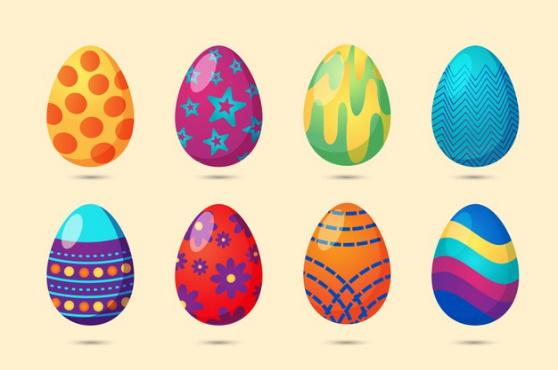
Many Ancient cultures viewed eggs as a symbol of life. Hindus, Egyptians, Persians, and Phoenicians believed the world begun with an enormous egg. The Persians, Greeks, and Chinese gave gifts of eggs during spring festivals in celebration of new life all around them (remember that we are talking about a Holiday that started in the Northern Hemisphere and therefore spring starts in March-April). Other sources say people ate dyed eggs at spring festivals in Egypt, Persia, Greece, and Rome. In ancient Druid lore, the eggs of serpents were sacred and stood for life.
Early Christians looked at the connection eggs had to life and decided eggs could be a part of their celebration of Christ’s resurrection. In addition, in some areas, eggs were forbidden during Lent; therefore, they were a delicacy at Easter. Since many of the earlier customs were Eastern in origin, some speculate that early missionaries or knights of the Crusade may have been responsible for bringing the tradition to the West.
Once the custom became accepted, new traditions began to grow up around it. Eggs were dyed red for joy and in memory of Christ’s blood. Egg rolling contests came to America from England, possibly as a reminder of the stone being rolled away.
What about the familiar Easter Egg hunt? One source suggested that it grew out of the tradition of German children searching for hidden pretzels during the Easter season. Since children were hiding nests for the Easter Bunny to fill with eggs at the same time they were hunting pretzels, it was only a small leap to begin hiding eggs instead.
(Adapted from here)
Discuss in the comments below:
1. What new information did you learn after reading the text?
2. What are the traditions explained in the text? Do we have them in Brazil? Do you and your family make use of those traditions?
3. Explain in no more than 300 words where Easter, the Easter Bunny and the Easter Eggs come from – or record an audio/video explaining this and share the link in the comments.